






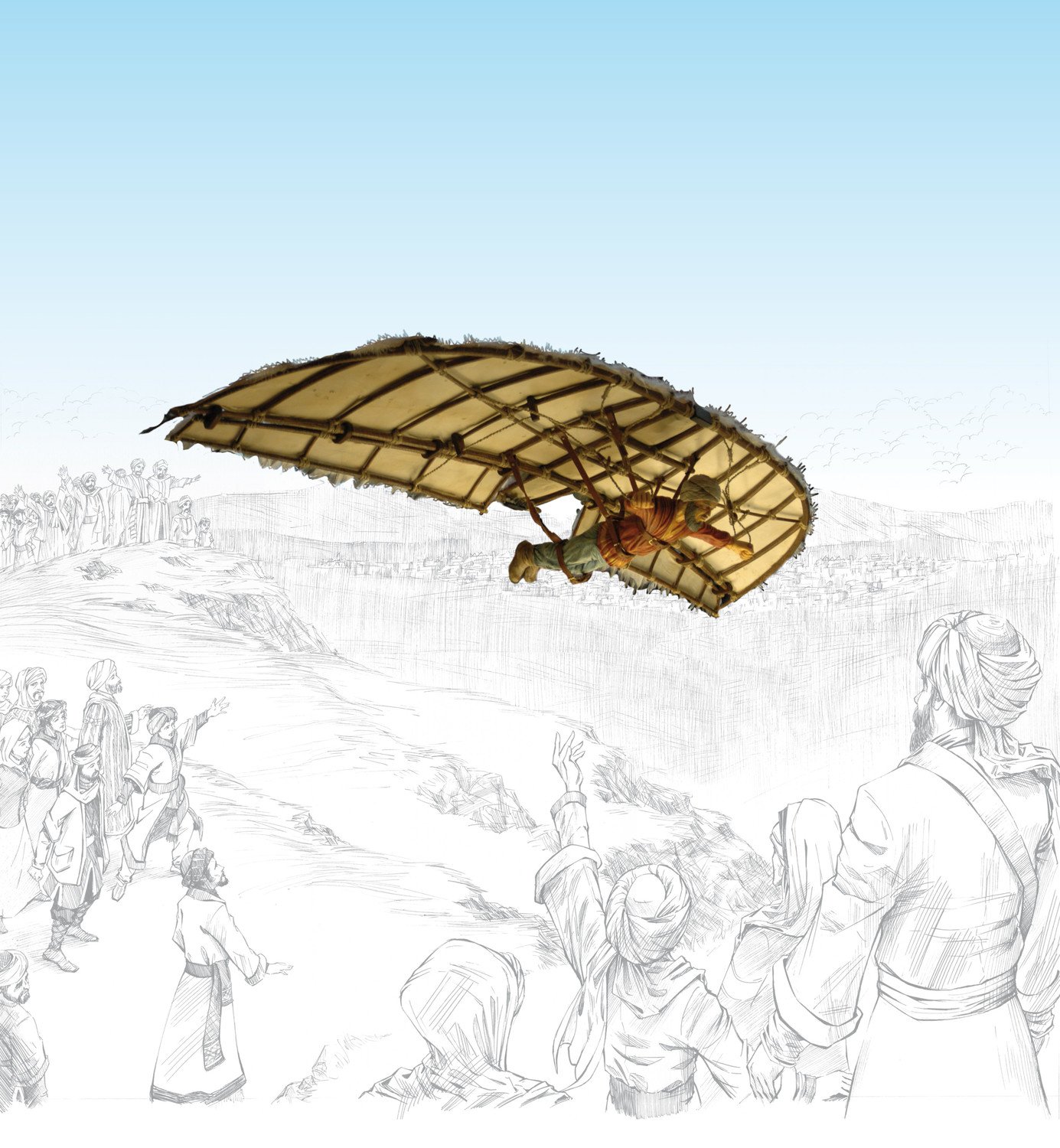
More than a thousand years before modern airplanes, a Muslim scientist named Abbas Ibn e Firnas attempted human flight. Born in 810 CE in Al Andalus, present-day Spain, Ibn e Firnas was a polymath. He worked in astronomy, engineering, poetry, and physics, but his bold experiments with flight made him a lasting historical figure.
Historical records show that in the 9th century, Ibn e Firnas designed a flying machine using silk, wood, and feathers. After years of study and preparation, he attempted a flight from an elevated area in Cordoba. According to historians, he managed to stay airborne for a short time, gliding rather than falling straight down. This made his experiment different from earlier jumps, which lacked planning or scientific thought.
Although he survived the landing, Ibn e Firnas was injured. He later realized that his design lacked a tail, which is essential for balance and safe landing. This observation shows his scientific mindset. He did not see failure as an end, but as a lesson. His understanding of aerodynamics came centuries before similar ideas appeared in Europe.
Many aviation historians recognize Abbas Ibn e Firnas as the father of aviation because he was the first known person to seriously attempt controlled flight using scientific principles. His work influenced later thinkers and stands as evidence of the advanced scientific culture of the Islamic Golden Age.
Today, his legacy is honored in various ways, including statues, airports, and bridges named after him. Abbas Ibn e Firnas remains a powerful reminder that early scientific progress was global, and that Muslim scholars played a key role in shaping human knowledge and innovation.